
[머신러닝] Chap 4 - Decision tree
Disclaimer
📣 본 포스트는 조우쯔화의 단단한 머신러닝 책을 요약 정리한 글입니다.
Chap 4. Decision tree
4.1 Basic process
- Decision Tree Learning algorithm
- Input : Testing set $D$, Feature set $A$
Process :
- generate node $i$
- if $\forall D \in C$ :
- Mark node $i$ as a class $C$ leaf node, return
- if $A=\varnothing \ \text{or} \ \forall D
$ take some value on $A$ :
- Mark node $i$ as a leaf node, label = majority class in $D$, return
- Set optimal splitting feature $a^*$ from $A$ (Entropy, GINI, etc…)
- for each value $a_{*}^{v}$ in $a_{*}$, do :
- Generate branch for node $i$ ; $D_v$ is subset of samples taking $a_{*}^{v} \text{on } a_{*}$
- if $D_v$ is empty :
- Mark $D_v$ as leaf node, label it with majority class in $D$, return
- else :
- $D_v$ = self($D_v$, $A \ \backslash \ {a_*}$)
Output : Decision tree with root node $i$
4.2 Split selection
Split by information entropy
- Information Entropy (or simply entropy)
- $f$ : Number of features
- Entropy 의미 : 클 수록 잘 분배되어 있는 것. 0에 가까울 수록 한쪽으로 편향되어 있다는 뜻 (작을 수록 순도가 높음)
- Gain of splitting samples by feature
- 모든 남아있는 feature에 대한 information gain을 계산하여 가장 gain이 높은 (엔트로피를 효과적으로 줄일 수 있는) feature를 택하여 분할을 진행
Split by gain ratio
- Gain ratio : Gain 자체가 커지게 하려면 attribute의 수가 많은 feature가 유리하게 작동함. 즉 이에 대한 보정을 하는 것이 gain ratio 보정(?)
- Gain ratio is biased towards features with fewer possible values : possible values 수가 많은 경우 (like case of ID) 저평가함.
Split by GINI Index
- Gini(D) : 임의의 2개 sample이 서로 다른 클래스일 확률. (Gini(D)가 클 수록 D의 purity는 높음)
- Gini index가 가장 작은 feature를 고름
4.3 Pruning
- Deal with overfitting.
- General strategies : pre/post-pruning
- First, using hold-out method, split dataset into training and validation set
Pre-pruning
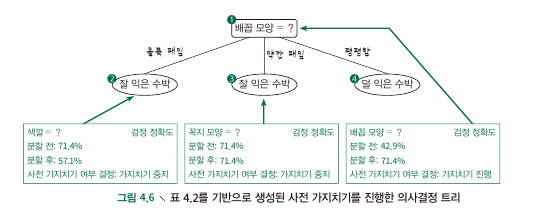
- comparing before/after splitting
- 가지치기를 하기 전에 splitting 과정에서부터 pre-pruning을 진행하는 것.
- validation set에 대한 accruacy를 splitting 전후로 계산, 그 rate가 늘어나지 않으면 prune, 그렇지 않으면 split
- Advantages : Reduce the risk of overfitting, computational cost of training and testing
- Disadvantages : Risk of underfitting
Post-pruning
- 이미 만들어진 decision tree에 대한 ‘post’ pruning
- 먼저 total tree에 대한 accruacy를 계산.
- 하위 node부터, pruning 전후의 accuracy 차이를 계산, 효용이 있다면 pruning 진행. (같다면 진행 x)
- Advantages : less prone to underfitting -> better generalization ability
- Disadvantages : training time of post-pruning is much longer (하위노드부터 하나씩 전부 따져봐야 하므로)
4.4 Continuous values & missing values
Continuous values
- Discetization Stretagy (Bi-partition) : Dataset D에서 feature a에 대해 t를 기준으로 2개의 group으로 나눔.
- 이 때 Split point의 후보 분할점이 되는 점
- Midpoint $T_a$가 사용되며, 이를 이용해 구한 Gain은 다음과 같음.
- a라는 property를 이용해 D를 분리할 때 t라는 새로운 변수까지 고려해서 gain이 최대화되는 t를 선택하겠다는 뜻.
Missing Values
- To solve problems :
- feature의 선택
- feature가 선택된 경우 샘플이 결측값이라면 어떻게 분할할 것인가.
- 특정 feature $a$에 대하여:
- $w_x$ : weight for sample $x$
- $D$ : total data
- $\tilde D$ : data that has values of $a$
- $\tilde D_k$ : $k$th sample(classifier’s ground truth)
- $\rho$ : 전체 Data 중 $a$의 데이터가 존재하는 비율 (weighted)
- $\tilde p_k$ : 결측값 없는 데이터 중 label : $k$의 비율 (weighted)
- $\tilde r_v$ : 결측값 없는 데이터 중 feature $a$에 대해서 $v$의 값을 갖는 비율 (weighted)
- Gain, Entropy의 재정의
- 만약 feature $a$로 분할 했는데 특정 sample $x$의 feature $a$가 결측값이라면, $x$를 모든 하위 node에 동일하게 귀속시키는 대신 그 가중치(weight)을 $w_x$에서 $\tilde r_v w_x$로 update한다.
4.5 Multivariate Decision Trees
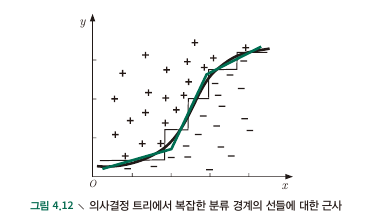
- Feature axis에 data point를 plot 하였을 때 Decision tree가 하는 일은 axis에 parallel한 경계선을 긋는 행위.
- Parallel하지 않은 대각선 line을 그릴 수 있다면?
댓글을 불러오는 중입니다.