
[C++] Chap 04 - Parameters and Overloading
Parameter call
Call by value
- A copy of actual argument is passed.
- When modified, only the “local copy” is changed
- Cannot declare the same parameter “again” inside the function. (Value arguments are like local variables)
Call by reference
- Argument MUST be a variable, not a constant
- A “reference” (memory location, address) is passed in.
- Specified by ampersand,
&, after type in formal param list
void swap(int& a, int& b); //swapped
void swap(int a, int b); //not swapped
void swap(int& a, int b) {
		int temp = a; //address of a
		a=b; // now value of a is b
		b=temp; // b
} // b, b
- To “protect” data and still pass by reference, use
constkeyword. → makes read-only functions- Pros : can reduce copying time
int num = 1;
int& num2 = num; //must be initiailized with parameter
//alias
int* adr = &num2; //same as &num
//&var : returns address of the variable
int returnVal(int& num){num++;return num;}
int& returnRef(int& num){num++;return num;}
int* rtnAddress(int& num) {return #}

int main(void){
    int num_1(1), num_2(1), num_3(1), num_4(1);
    int new_num_1 = returnVal(num_1);
    //new_num=2(new add), num_1=2
    int& new_num_2 = returnVal(num_2); //ILLEGAL
    //can't assign literal to reference type variable
    int new_num_3 = returnRef(num_3);
    //copies value of returned ref to new_num_3
    //new_num3=2(new add); num_3=2;
    int& new_num_4 = returnRef(num_4);
    //new_num_4 = num4(2); num_4 = 2;
    int* add = rtnAddress(num_4);
    cout<<add <<endl;
    cout<<*add<<endl;

    new_num_1++; //new_num1=3; num_1=2;
    new_num_3++; //new_num3=3; num_3=2;
    new_num_4++; //new_num4=num_4; num_4=3;

    cout <<  new_num_1 << new_num_3 << new_num_4
         << num_1 << num_3 << num_4 << endl;
         //333223
}
Function Overloading
- Same function name, but different param lists
- Function “signature”
- Function name
- parameter list (excluding & and const)
Overloading
- How much can we overload?
- Different number of formal params : Yes
- One or more parameters with differen types : Yes
- Different return type with the same formal parameters : No
- Difference in const or call-by-value/reference : No
- In case of return type and const, call by val/ref, we can’t distinguish in the function call stage
- Automatic type conversion + overloading can cause some confusion
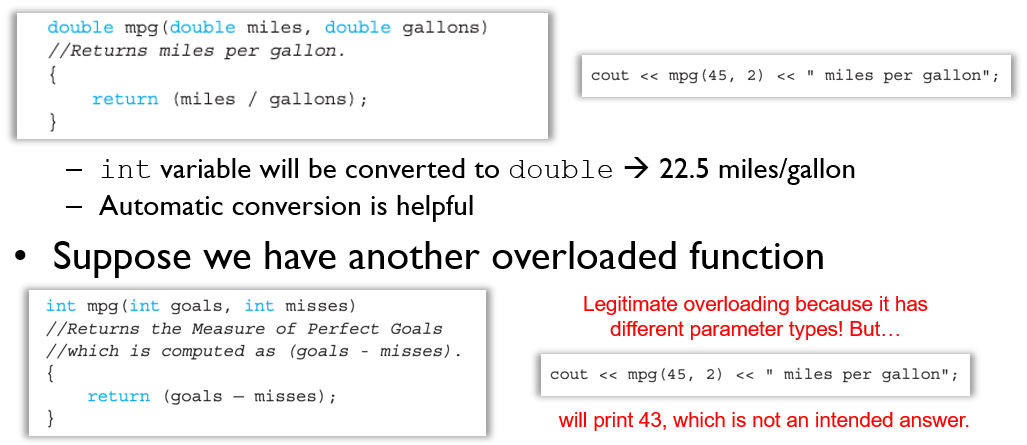
Overloading Resolution
- Exact Match (Looking for exact signature)
- Compatible Match
- 1st with promotion (int → double)
- 2nd with demotion (double → int) (possible loss of data)
 void foo(int a, int b);
 void foo(double a, double b);

 int main() {
		 int a=0;
		 double b=1.0;
		 foo(a, b); // Ambiguous
 }
 // A function is seleced when it wins at every parameter
Default Arguments
- Allow omitting some arguments
- Specified in function declaration / prototype
void showVol(int length, int width=1, int height=1);
- A default argument should not be given a second time (at implementation)
- Default parameters are filled up from the right side : cannot leave out the middle parameter to default
showVol(5, default, 4); //impossible
showVol(5, 4); // height = 1
void foo(int a);
void foo(int a, int b=2);

int main() {
	foo(1); //ambiguous call : overloading resolution error
}
댓글을 불러오는 중입니다.